
7 Local SEO Metrics That Actually Predict Revenue in 2026 (and the Vanity Ones to Ignore)
- October 30, 2026
- Uncategorized
Local SEO reporting often produces a large number of charts, percentages, and ranking positions. The difficulty is that not every improvement reflects business growth. More impressions may be useful, but they do not necessarily mean more customers. A higher keyword position can be encouraging, but it is not revenue by itself.
In 2026, local businesses need a measurement framework that follows the complete customer journey:
Visibility → engagement → qualified leads → customers → revenue
This approach is particularly important as search results continue to evolve through map interfaces, AI-generated summaries, click-to-call actions, and direct booking features. The following seven metrics are among the most useful for understanding whether local SEO is producing commercial value.
1. Map Pack visibility for high-intent searches
Map Pack visibility measures how often a business appears in the local three-pack or prominent map results for relevant searches.
This is more useful than tracking one average ranking position because local rankings vary according to:
- The searcher’s location
- The device being used
- The wording of the query
- The business category
- Competitor activity
- Whether the search is branded or non-branded
A local plumber, for example, should not only measure rankings for its business name. It should also monitor visibility for searches such as “emergency plumber near me,” “water heater repair,” or “plumber in [city].”
Map Pack visibility is a leading indicator rather than a final revenue metric. It shows that the business is being presented when demand exists. To establish whether that visibility matters, compare it with calls, website clicks, direction requests, and booked jobs.
It is worth tracking:
- Appearance frequency for priority local searches
- Visibility by service and location
- Branded versus non-branded searches
- Search versus Maps performance
- Competitor presence in the same local results
A business that appears more frequently for commercial searches has more opportunities to generate revenue. However, ranking alone should not be treated as proof of success.
2. Google Business Profile actions
Google Business Profile actions are among the clearest indicators of local search engagement. Google’s Business Profile Performance documentation identifies key interactions such as calls, website clicks, and direction requests.
These actions are valuable because they usually represent a stronger level of intent than a passive impression. A person who requests directions or clicks to call is generally closer to making a decision than someone who merely sees a listing.
Track the following actions by location and month:
- Phone-button clicks
- Website clicks
- Direction requests
- Booking actions
- Messages, where available
- Product or service interactions, where relevant
There is an important qualification: a Google Business Profile “call” is a click on the call button, not necessarily a completed or connected conversation. Google explains the distinction in its Business Profile metrics documentation. Call tracking and CRM records are still required to determine whether the interaction became a genuine lead.
A useful rate to calculate is:
Profile action rate = total profile actions ÷ profile views
This helps distinguish growth caused by greater visibility from growth caused by a more persuasive profile.

3. Qualified calls, not total calls
Total call volume is helpful, but it can be misleading. Some calls may come from outside the service area, ask about services the business does not provide, or represent existing customers rather than new opportunities.
Qualified calls provide a more accurate view of local SEO performance. A qualified call should meet the business’s own criteria, such as:
- The caller is located in the service area
- The caller needs a service that the business provides
- The caller has a realistic purchasing intent
- The opportunity has not already been captured through another channel
The most useful calculations include:
Qualified call rate = qualified calls ÷ total tracked calls
Booked-job rate = booked jobs ÷ qualified calls
Revenue per qualified call = revenue from local calls ÷ qualified calls
For example, 100 monthly calls may appear impressive. If only 18 are relevant and four become customers, the business should focus on improving targeting and lead handling rather than celebrating the larger number.
Call tracking software can record source data, duration, recordings, and outcomes. Connecting that information to a CRM makes it possible to identify which calls became estimates, appointments, sales, or repeat customers.
4. Local conversion rate
Local conversion rate measures how effectively local search traffic becomes a meaningful business action. Depending on the company, a conversion may be:
- A quote request
- A phone call
- An appointment
- A booking
- A completed purchase
- A direction request
- A request for a consultation
For website traffic, calculate conversion rate by source and location rather than relying only on the website-wide average:
Local conversion rate = local conversions ÷ local sessions
A visitor from a nearby city searching for a specific service should not be grouped without context with a visitor reading a general informational article from another state.
It is also useful to compare conversion rates among:
- Google Business Profile traffic
- Local organic traffic
- Branded searches
- Non-branded service searches
- Mobile and desktop visitors
- New and returning visitors
This metric often exposes problems that rankings cannot. A business may have strong visibility but a weak conversion rate because its landing page is slow, its phone number is difficult to find, or its service area is unclear.
This is alright, but it means the SEO strategy cannot be separated from website usability. Web Social Pro’s conversion rate optimization services focus on improving the steps between visibility and action.
5. Review velocity and review quality
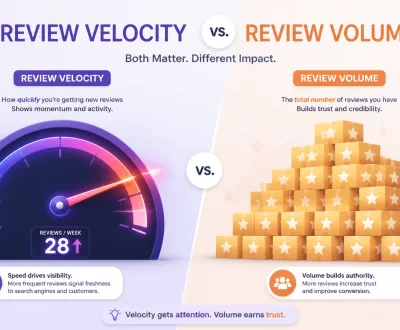
Review volume still matters, but total reviews are only one part of the picture. Review velocity measures how consistently a business receives new, genuine reviews over time.
A profile with 150 reviews but no new feedback for a year may appear less current than a competitor with 80 reviews and a steady stream of recent customer experiences. Industry analyses from sources such as Localo’s review velocity study increasingly distinguish between historical volume, recency, and ongoing review activity.
Monitor:
- New reviews per month
- Reviews received in the past 30, 60, and 90 days
- Average rating
- Rating distribution
- Review response rate
- Common service and location themes in reviews
Velocity should not become a target for artificial review generation. Sudden, unnatural spikes can create compliance and trust concerns. The objective is a repeatable process that invites genuine feedback from real customers.
Review content also provides qualitative insight. If customers repeatedly mention “same-day service,” “clear pricing,” or a particular neighborhood, those themes can inform website content and local landing pages.
Web Social Pro has also covered the different roles of Google and Facebook reviews. For local search visibility, Google reviews generally deserve priority because they are integrated directly into Google’s local ecosystem.
6. Lead-to-customer conversion rate and lead quality
SEO can generate leads without generating profitable customers. Lead quality measures what happens after an inquiry enters the business.
Track the progression from:
- Local search interaction
- Lead or inquiry
- Qualified opportunity
- Estimate or appointment
- Closed customer
- Repeat purchase or referral
The key calculation is:
Lead-to-customer rate = new customers from local leads ÷ qualified local leads
For businesses with different service lines, measure this by service. A lower-volume service may produce considerably more revenue per customer than a popular but less profitable service.
It is also worth tracking:
- Average revenue per local customer
- Gross margin by lead source
- Customer lifetime value
- No-show rate
- Sales response time
- Repeat customer rate
This is where CRM data becomes essential. Google Analytics and Business Profile data can show interactions, but they usually cannot determine whether a phone inquiry became a profitable sale. That information must come from sales records, booking systems, or a carefully maintained lead database.
7. Revenue attributed to local SEO
Revenue attributed to local SEO is the most direct measure of commercial performance. Attribution will not always be perfect, especially for businesses that receive phone calls, walk-ins, and repeat purchases. Even so, a consistent attribution model is more useful than ignoring revenue entirely.
Use:
- UTM-tagged links in the Business Profile
- Dedicated call tracking
- Form source fields
- CRM campaign attribution
- Booking and ecommerce tracking
- Customer surveys asking how the business was found
For online transactions, revenue can often be recorded directly. For offline services, businesses may use estimated values based on historical close rates and average order values.
A simple return calculation is:
Local SEO ROI = (attributed revenue − local SEO cost) ÷ local SEO cost
It is sensible to compare both first-touch and last-touch attribution. Local SEO may introduce a customer, while email, direct traffic, or a later phone call completes the sale. Neither interaction should automatically receive all the credit.

Vanity metrics to stop obsessing over
Vanity metrics are not always useless. They become a problem when they are presented as business outcomes without context.
Use caution with:
Raw impressions
Impressions show that a listing or page was displayed. They do not show whether the searcher was in the service area, had commercial intent, or took action.
Total website traffic
Traffic can grow while qualified leads decline. Segment traffic by location, source, landing page, and conversion behavior.
Average keyword position
An average ranking can hide poor visibility for the searches that actually generate customers. Track important services, locations, devices, and search types separately.
Total review count
A large historical review count is helpful, but recent activity, rating quality, and relevance often provide a more current picture.
Search volume
High-volume keywords are not automatically valuable. A lower-volume query such as “commercial roof repair in [city]” may generate more revenue than a broad term with substantially more searches.
Social followers and likes
These can support brand awareness, but they should not be treated as local SEO revenue metrics unless they can be connected to qualified traffic, leads, or sales.

Build a revenue-focused local SEO dashboard
A practical monthly dashboard does not need dozens of metrics. It should connect a small number of measures across the funnel:
- Map Pack visibility
- Google Business Profile actions
- Qualified calls
- Local conversion rate
- Review velocity
- Lead-to-customer rate
- Attributed revenue
Review the data by location, service, and time period. Then compare changes against operational factors such as staffing, seasonality, promotions, service availability, and sales response time.
Local SEO is a long-term process. Rankings can fluctuate, and attribution can remain imperfect. That shouldn’t really make a difference if the reporting system consistently shows whether visibility is producing qualified opportunities and profitable customers.
Web Social Pro helps local businesses connect local SEO strategy with website performance, reputation management, content, and lead generation. To assess your current search performance, you can request a free SEO analysis or contact Web Social Pro. We are available to help identify which metrics deserve attention and which can be safely removed from your reports.
About us and this blog
We are a digital marketing company with a focus on helping our customers achieve great results across several key areas.
Request a free quote
We offer professional SEO services that help websites increase their organic search score drastically in order to compete for the highest rankings even when it comes to highly competitive keywords.
Subscribe to our newsletter!
More from our blog
See all posts